 The everyday practical activity of tribesmen reproduces, or perpetuates, a tribe. This reproduction is not merely physical, but social as well. Through their daily activities the tribesmen do not merely reproduce a group of human beings; they reproduce a tribe, namely a particular social form within which this group of human beings performs specific activities in a specific manner. The specific activities of the tribesmen are not the outcome of « natural » characteristics of the men who perform them, the way the production of honey is an outcome of the « nature » of a bee. The daily life enacted and perpetuated by the tribesman is a specific social response to particular material and historical conditions.
The everyday activity of slaves reproduces slavery. Through their daily activities, slaves do not merely reproduce themselves and their masters physically; they also reproduce the instruments with which the master represses them, and their own habits of submission to the master's authority. To men who live in a slave society, the master-slave relation seems like a natural and eternal relation. However, men are not born masters or slaves. Slavery is a specific social form, and men submit to it only in very particular material and historical conditions.
The practical everyday activity of wage-workers reproduces wage labor and capital. Through their daily activities, "modern" men, like tribesmen and slaves, reproduce the inhabitants, the social relations and the ideas of their society; they reproduce the social form of daily life. Like the tribe and the slave system, the capitalist system is neither the natural nor the final form of human society; like the earlier social forms, capitalism is a specific response to material and historical conditions.
Unlike earlier forms of social activity, everyday life in capitalist society systematically transforms the material conditions to which capitalism originally responded. Some of the material limits to human activity come gradually under human control. At a high level of industrialization, practical activity creates its own material conditions as well as its social form. Thus the subject of analysis is not only how practical activity in capitalist society reproduces capitalist society, but also how this activity itself eliminates the material conditions to which capitalism is a response.
The social form of people's regular activities under capitalism is a response to a certain material and historical situation. The material and historical conditions explain the origin of the capitalist form, but do not explain why this form continues after the initial situation disappears. A concept of « cultural lag » is not an explanation of the continuity of a social form after the disappearance of the initial conditions to which it responded. This concept is merely a name for the continuity of the social form. When the concept of « cultural lag » parades as a name for a « social force » which determines human activity, it is an obfuscation which presents the outcome of people's activities as an external force beyond their control. This is not only true of a concept like « cultural lag. » Many of the terms used by Marx to describe people's activities have been raised to the status of external and even « natural » forces which determine people's activity; thus concepts like « class struggle, » « production relations » and particularly « The Dialectic, » play the same role in the theories of some « Marxists » that « Original Sin, » « Fate » and « The Hand of Destiny » played in the theories of medieval mystifiers.
In the performance of their daily activities, the members of Capitalist society simultaneously carry out two processes: they reproduce the form of their activities, and they eliminate the material conditions to which this form of activity initially responded. But they do not know they carry out these processes; their own activities are not transparent to them. They are under the illusion that their activities are responses to natural conditions beyond their control, and do not see that they are themselves authors of those conditions. The task of capitalist ideology is to maintain the veil which keeps people from seeing that their own activities reproduce the form of their daily life: the task of critical theory is to unveil the activities of daily life, to render them transparent, to make the reproduction of the social form of capitalist activity visible within people's daily activities.
Under capitalism, daily life consists of related activities which reproduce and expand the capitalist form of social activity. The sale of labor-time for a price (a wage), the embodiment of labor-time in commodities (salable goods, both tangible and intangible), the consumption of tangible and intangible commodities (such as consumer goods and spectacles)--these activities which characterize daily life under capitalism are not manifestations of « human nature », nor are they imposed on men by forces beyond their control.
If it is held that man is « by nature » an uninventive tribesman and an inventive businessman, a submissive slave and a proud craftsman, an independent hunter and a dependent wage-worker, then either man's « nature » is an empty concept, or man's « nature » depends on material and historical conditions, and is in fact a response to those conditions.
In capitalist society, creative activity takes the form of commodity production, namely production of marketable goods, and the results of human activity take the form of commodities. Marketability or salability is the universal characteristic of all practical activity and all products.
The products of human activity which are necessary for survival have the form of salable goods: they are only available in exchange for money. And money is only available in exchange for commodities. If a large number of men accept the legitimacy of these conventions, if they accept the convention that commodities are a prerequisite for money, and that money is a prerequisite for survival, then they find themselves locked into a vicious circle. Since they have no commodities, their only exit from this circle is to regard themselves, or parts of themselves, as commodities. And this is, in fact, the peculiar « solution » which men impose on themselves in the face of specific material and historical conditions. They do not exchange their bodies or parts of their bodies for money. They exchange the creative content of their lives, their practical daily activity, for money.
As soon as men accept money as an equivalent for life, the sale of living activity becomes a condition for their physical and social survival. Life is exchanged for survival. Creation and production come to mean sold activity. A man's activity is « productive, » useful to society, only when it is sold activity. And the man himself is a productive member of society only if the activities of his daily life are sold activities. As soon as people accept the terms of this exchange, daily activity takes the form of universal prostitution.
The sold creative power, or sold daily activity, takes the form of labor. Labor is a historically specific form of human activity. Labor is abstract activity which has only one property: it is marketable, it can be sold for a given quantity of money. Labor is indifferent activity: indifferent to the particular task performed and indifferent to the particular subject to which the task is directed. Digging, printing and carving are different activities, but all three are labor in capitalist society. Labor is simply « earning money. » Living activity which takes the form of labor is a means to earn money. Life becomes a means of survival.
This ironic reversal is not the dramatic climax of an imaginative novel; it is a fact of daily life in capitalist society. Survival, namely self-presentation and reproduction, is not the means to creative practical activity, but precisely the other way around. Creative activity in the form of labor, namely sold activity, is a painful necessity for survival; labor is the means to self-preservation and reproduction.
The sale of living activity brings about another reversal. Through sale, the labor of an individual becomes the « property » of another, it is appropriated by another, it comes under the control of another. In other words, a person's activity becomes the activity of another, the activity of its owner; it becomes alien to the person who performs it. Thus one's life, the accomplishments of an individual in the world, the difference which his life makes in the life of humanity, are not only transformed into labor, a painful condition for survival; they are transformed into alien activity, activity performed by the buyer of that labor. In capitalist society, the architects, the engineers, the laborers, are not builders; the man who buys their labor is the builder; their projects, calculations and motions are alien to them; their living activity, their accomplishments, are his.
Academic sociologists, who take the sale of labor for granted, understand this alienation of labor as a feeling: the worker's activity « appears » alien to the worker, it « seems » to be controlled by another. However, any worker can explain to the academic sociologists that the alienation is neither a feeling nor an idea in the worker's head, but a real fact about the worker's daily life. The sold activity is in fact alien to the worker; his labor is in fact controlled by its buyer.
In exchange for his sold activity, the worker gets money, the conventionally accepted means of survival in capitalist society. With this money he can buy commodities, things, but he cannot buy back his activity. This reveals a peculiar « gap » in money as the « universal equivalent. » A person can sell commodities for money, and he can buy the same commodities with money. He can sell his living activity for money, but he cannot buy his living activity for money.
The things the worker buys with his wages are first of all consumer goods which enable him to survive, to reproduce his labor-power so as to be able to continue selling it; and they are spectacles, objects for passive admiration. He consumes and admires the products of human activity passively. He does not exist in the world as an active agent who transforms it, but as a helpless, impotent spectator; he may call this state of powerless admiration « happiness, » and since labor is painful, he may desire to be « happy, » namely inactive, all his life (a condition similar to being born dead). The commodities, the spectacles, consume him; he uses up living energy in passive admiration; he is consumed by things. In this sense, the more he has, the less he is. (An individual can surmount this death-in-life through marginal creative activity; but the population cannot, except by abolishing the capitalist form of practical activity, by abolishing wage-labor and thus de-alienating creative activity.)
By alienating their activity and embodying it in commodities, in material receptacles of human labor, people reproduce themselves and create Capital.
From the standpoint of capitalist ideology, and particularly of academic Economics, this statement is untrue: commodities are « not the product of labor alone » ; they are produced by the primordial « factors of production, » Land, Labor and Capital, the capitalist Holy Trinity, and the main « factor » is obviously the hero of the piece, Capital.
The purpose of this superficial Trinity is not analysis, since analysis is not what these Experts are paid for. They are paid to obfuscate, to mask the social form of practical activity under capitalism, to veil the fact that producers reproduce themselves, their exploiters, as well as the instruments with which they're exploited. The Trinity formula does not succeed in convincing. It is obvious that land is no more of a commodity producer than water, air, or the sun. Furthermore Capital, which is at once a name for a social relation between workers and capitalists, for the instruments of production owned by a capitalist, and for the money-equivalent of his instruments and « intangibles, » does not produce anything more than the ejaculations shaped into publishable form by the academic Economists. Even the instruments of production which are the capital of one capitalist are primordial « factors of production » only if one's blinders limit his view to an isolated capitalist firm, since a view of the entire economy reveals that the capital of one capitalist is the material receptacle of the labor alienated to another capitalist. However, though the Trinity formula does not convince, it does accomplish the task of obfuscation by shifting the subject of the question: instead of asking why the activity of people under capitalism takes the form of wage-labor, potential analysts of capitalist daily life are transformed into academic house-Marxists who ask whether or not labor is the only « factor of production. »
Thus Economics (and capitalist ideology in general) treats land, money, and the products of labor, as things which have the power to produce, to create value, to work for their owners, to transform the world. This is what Marx called the fetishism which characterizes people's everyday conceptions, and which is raised to the level of dogma by Economics. For the economist, living people are things ( « factors of production » ), and things live (money « works, » Capital « produces » ).
The fetish worshipper attributes the product of his own activity to his fetish. As a result, he ceases to exert his own power (the power to transform nature, the power to determine the form and content of his daily life); he exerts only those « powers » which he attributes to his fetish (the « power » to buy commodities). In other words, the fetish worshipper emasculates himself and attributes virility to his fetish.
But the fetish is a dead thing, not a living being; it has no virility. The fetish is no more than a thing for which, and through which, capitalist relations are maintained. The mysterious power of Capital, its « power » to produce, its virility, does not reside in itself, but in the fact that people alienate their creative activity, that they sell their labor to capitalists, that they materialize or reify their alienated labor in commodities. In other words, people are bought with the products of their own activity, yet they see their own activity as the activity of Capital, and their own products as the products of Capital. By attributing creative power to Capital and not to their own activity, they renounce their living activity, their everyday life, to Capital, which means that people give themselves, daily, to the personification of Capital, the capitalist.
By selling their labor, by alienating their activity, people daily reproduce the personifications of the dominant forms of activity under capitalism, they reproduce the wage-laborer and the capitalist. They do not merely reproduce the individuals physically, but socially as well; they reproduce individuals who are sellers of labor-power, and individuals who are owners of means of production; they reproduce the individuals as well as the specific activities, the sale as well as the ownership.
Every time people perform an activity they have not themselves defined and do not control, every time they pay for goods they produced with money they received in exchange for their alienated activity, every time they passively admire the products of their own activity as alien objects procured by their money, they give new life to Capital and annihilate their own lives.
The aim of the process is the reproduction of the relation between the worker and the capitalist. However, this is not the aim of the individual agents engaged in it. Their activities are not transparent to them; their eyes are fixed on the fetish that stands between the act and its result. The individual agents keep their eyes fixed on things, precisely those things for which capitalist relations are established. The worker as producer aims to exchange his daily labor for money-wages, he aims precisely for the thing through which his relation to the capitalist is re-established, the thing through which he reproduces himself as a wage-worker and the other as a capitalist. The worker as consumer exchanges his money for products of labor, precisely the things which the capitalist has to sell in order to realize his Capital.
The daily transformation of living activity into Capital is mediated by things, it is not carried out by the things. The fetish worshipper does not know this; for him labor and land, instruments and money, entrepreneurs and bankers, are all « factors » and « agents. » When a hunter wearing an amulet downs a deer with a stone, he may consider the amulet an essential « factor » in downing the deer and even in providing the deer as an object to be downed. If he is a responsible and well-educated fetish worshipper, he will devote his attention to his amulet, nourishing it with care and admiration; in order to improve the material conditions of his life, he will improve the way he wears his fetish, not the way he throws the stone; in a bind, he may even send his amulet to « hunt » for him. His own daily activities are not transparent to him: when he eats well, he fails to see that it is his own action of throwing the stone, and not the action of the amulet, that provided his food; when he starves, he fails to see that it is his own action of worshipping the amulet instead of hunting, and not the wrath of his fetish, that causes his starvation.
The fetishism of commodities and money, the mystification of one's own daily activities, the religion of everyday life which attributes living activity to inanimate things, is not a mental caprice born in men's imaginations; it has its origin in the character of social relations under capitalism. Men do in fact relate to each other through things; the fetish is in fact the occasion for which they act collectively, and through which they reproduce their activity. But it is not the fetish that performs the activity. It is not Capital that transforms raw materials, nor Capital that produces goods. If living activity did not transform the materials, these would remain untransformed, inert, dead matter. If men were not disposed to continue selling their living activity, the impotence of Capital would be revealed; Capital would cease to exist; its last remaining potency would be the power to remind people of a bypassed form of everyday life characterized by daily universal prostitution.
The worker alienates his life in order to preserve his life. If he did not sell his living activity he would not get a wage and could not survive. However, it is not the wage that makes alienation the condition for survival. If men were collectively not disposed to sell their lives, if they were disposed to take control over their own activities, universal prostitution would not be a condition for survival. It is people's disposition to continue selling their labor, and not the things for which they sell it, that makes the alienation of living activity necessary for the preservation of life.
The living activity sold by the worker is bought by the capitalist. And it is only this living activity that breathes life into Capital and makes it « productive. » The capitalist, an « owner » of raw materials and instruments of production, presents natural objects and products of other people's labor as his own « private property. » But it is not the mysterious power of Capital that creates the capitalist's « private property »; living activity is what creates the « property, » and the form of that activity is what keeps it « private. »
The transformation of living activity into Capital takes place through things, daily, but is not carried out by things. Things which are products of human activity seem to be active agents because activities and contacts are established for and through things, and because people's activities are not transparent to them; they confuse the mediating object with the cause.
In the capitalist process of production, the worker embodies or materializes his alienated living energy in an inert object by using instruments which are embodiments of other people's activity. (Sophisticated industrial instruments embody the intellectual and manual activity of countless generations of inventors, improvers and producers from all corners of the globe and from varied forms of society.) The instruments in themselves are inert objects; they are material embodiments of living activity, but are not themselves alive. The only active agent in the production process is the living laborer. He uses the products of other people's labor and infuses them with life, so to speak, but the life is his own; he is not able to resurrect the individuals who stored their living activity in his instrument. The instrument may enable him to do more during a given time period, and in this sense it may raise his productivity. But only the living labor which is able to produce can be productive.
For example, when an industrial worker runs an electric lathe, he uses products of the labor of generations of physicists, inventors, electrical engineers, lathe makers. He is obviously more productive than a craftsman who carves the same object by hand. But it is in no sense the "Capital" at the disposal of the industrial worker which is more "productive" than the "Capital" of the craftsman. If generations of intellectual and manual activity had not been embodied in the electric lathe, if the industrial worker had to invent the lathe, electricity, and the electric lathe, then it would take him numerous lifetimes to turn a single object on an electric lathe, and no amount of Capital could raise his productivity above that of the craftsman who carves the object by hand.
The notion of the "productivity of capital," and particularly the detailed measurement of that "productivity," are inventions of the "science" of Economics, that religion of capitalist daily life which uses up people's energy in the worship, admiration and flattery of the central fetish of capitalist society. Medieval colleagues of these "scientists" performed detailed measurements of the height and width of angels in Heaven, without ever asking what angels or Heaven were, and taking for granted the existence of both.
The result of the worker's sold activity is a product which does not belong to him. This product is an embodiment of his labor, a materialization of a part of his life, a receptacle which contains his living activity, but it is not his; it is as alien to him as his labor. He did not decide to make it, and when it is made he does not dispose of it. If he wants it, he has to buy it. What he has made is not simply a product with certain useful properties; for that he did not need to sell his labor to a capitalist in exchange for a wage; he need only have picked the necessary materials and the available tools, he need only have shaped the materials guided by his goals and limited by his knowledge and ability. (It is obvious that an individual can only do this marginally; men's appropriation and use of the materials and tools available to them can only take place after the overthrow of the capitalist form of activity.)
What the worker produces under capitalist conditions is a product with a very specific property, the property of salability. What his alienated activity produces is a commodity.
Because capitalist production is commodity production, the statement that the goal of the process is the satisfaction of human needs is false; it is a rationalization and an apology. The "satisfaction of human needs" is not the goal of the capitalist or of the worker engaged in production, nor is it a result of the process. The worker sells his labor in order to get a wage; the specific content of the labor is indifferent to him; he does not alienate his labor to a capitalist who does not give him a wage in exchange for it, no matter how many human needs this capitalist's products may satisfy. The capitalist buys labor and engages it in production in order to emerge with commodities which can be sold. He is indifferent to the specific properties of the product, just as he is indifferent to peoples needs; all that interests him about the product is how much it will sell for, and all that interests him about people's needs is how much they "need" to buy and how they can be coerced, through propaganda and psychological conditioning, to "need" more. The capitalist's goal is to satisfy his need to reproduce and enlarge Capital, and the result of the process is the expanded reproduction of wage labor and Capital (which are not "human needs").
The commodity produced by the worker is exchanged by the capitalist for a specific quantity of money; the commodity is a value which is exchanged for an equivalent value. In other words, the living and past labor materialized in the product can exist in two distinct yet equivalent forms, in commodities and in money, or in what is common to both, value. This does not mean that value is labor. Value is the social form of reified (materialized) labor in capitalist society.
Under capitalism, social relations are not established directly; they are established through value. Everyday activity is not exchanged directly; it is exchanged in the form of value. Consequently, what happens to living activity under capitalism cannot be traced by observing the activity itself, but only by following the metamorphoses of value.
When the living activity of people takes the form of labor (alienated activity), it acquires the property of exchangeability; it acquires the form of value. In other words, the labor can be exchanged for an "equivalent" quantity of money (wages). The deliberate alienation of living activity, which is perceived as necessary for survival by the members of capitalist society, itself reproduces the capitalist form within which alienation is necessary for survival. Because of the fact that living activity has the form of value, the products of that activity must also have the form of value: they must be exchangeable for money. This is obvious since, if the products of labor did not take the form of value, but for example the form of useful objects at the disposal of society, then they would either remain in the factory or they would be taken freely by the members of society whenever a need for them arose; in either case, the money-wages received by the workers would have no value, and living activity could not be sold for an "equivalent" quantity of money; living activity could not be alienated. Consequently, as soon as living activity takes the form of value, the products of that activity take the form of value, and the reproduction of everyday life takes place through changes or metamorphoses of value.
The capitalist sells the products of labor on a market; he exchanges them for an equivalent sum of money; he realizes a determined value. The specific magnitude of this value on a particular market is the price of the commodities. For the academic Economist, Price is St. Peter's key to the gates of Heaven. Like Capital itself, Price moves within a wonderful world which consists entirely of objects; the objects have human relations with each other, and are alive; they transform each other, communicate with each other; they marry and have children. And of course it is only through the grace of these intelligent, powerful and creative objects that people can be so happy in capitalist society.
In the Economist's pictorial representations of the workings of Heaven, the angels do everything and men do nothing at all; men simply enjoy what these superior beings do for them. Not only does Capital produce and money work; other mysterious beings have similar virtues. Thus Supply, a quantity of things which are sold, and Demand, a quantity of things which are bought, together determine Price, a quantity of money; when Supply and Demand marry on a particular point of the diagram, they give birth to Equilibrium Price, which corresponds to a universal state of bliss. The activities of everyday life are played out by things, and people are reduced to things ("factors of production") during their "productive" hours, and to passive spectators of things during their "leisure time." The virtue of the Economic Scientist consists of his ability to attribute the outcome of people's everyday activities to things, and of his inability to see the living activity of people underneath the antics of the things. For the Economist, the things through which the activity of people is regulated under capitalism are themselves the mothers and sons, the causes and consequences of their own activity.
The magnitude of value, namely the price of a commodity, the quantity of money for which it exchanges, is not determined by things, but by the daily activities of people. Supply and demand, perfect and imperfect competition, are nothing more than social forms of products and activities in capitalist society; they have no life of their own. The fact that activity is alienated, namely that labor-time is sold for a specific sum of money, that it has a certain value, has several consequences for the magnitude of the value of the products of that labor. The value of the sold commodities must at least be equal to the value of the labor-time. This is obvious both from the standpoint of the individual capitalist firm, and from the standpoint of society as a whole. If the value of the commodities sold by the individual capitalist were smaller than the value of the labor he hired, then his labor expenditures alone would be larger than his earnings, and he would quickly go bankrupt. Socially, if the value of the laborers' production were smaller than the value of their consumption, then the labor force could not even reproduce itself, not to speak of a class of capitalists. However, if the value of the commodities were merely equal to the value of the labor-time expended on them, the commodity producers would merely reproduce themselves, and their society would not be a capitalist society; their activity might still consist of commodity production, but it would not be capitalist commodity production.
For labor to create Capital, the value of the products of labor must be larger than the value of the labor. In other words, the labor force must produce a surplus product, a quantity of goods which it does not consume, and this surplus product must be transformed into surplus value, a form of value which is not appropriated by workers as wages, but by capitalists as profit. Furthermore, the value of the products of labor must be larger still, since living labor is not the only kind of labor materialized in them. In the production process, workers expend their own energy, but they also use up the stored labor of others as instruments, and they shape materials on which labor was previously expended.
This leads to the strange result that the value of the laborer's products and the value of his wage are different magnitudes, namely that the sum of money received by the capitalist when he sells the commodities produced by his hired laborers is different from the sum he pays the laborers. This difference is not explained by the fact that the used-up materials and tools must be paid for. If the value of the sold commodities were equal to the value of the living labor and the instruments, there would still be no room for capitalists. The fact is that the difference between the two magnitudes must be large enough to support a class of capitalists--not only the individuals, but also the specific activity that these individuals engage in, namely the purchase of labor. The difference between the total value of the products and the value of the labor spent on their production is surplus value, the seed of Capital.
In order to locate the origin of surplus value, it is necessary to examine why the value of the labor is smaller than the value of the commodities produced by it. The alienated activity of the worker transforms materials with the aid of instruments, and produces a certain quantity of commodities. However, when these commodities are sold and the used-up materials and instruments are paid for, the workers are not given the remaining value of their products as their wages; they are given less. In other words, during every working day, the workers perform a certain quantity of unpaid labor, forced labour, for which they receive no equivalent.
The performance of this unpaid labor, this forced labor, is another "condition for survival" in capitalist society. However, like alienation, this condition is not imposed by nature, but by the collective practice of people, by their everyday activities. Before the existence of unions, an individual worker accepted whatever forced labor was available, since rejection of the labor would have meant that other workers would accept the available terms of exchange, and the individual worker would receive no wage. Workers competed with each other for the wages offered by capitalists; if a worker quit because the wage was unacceptably low, an unemployed worker was willing to replace him, since for the unemployed a small wage is higher than no wage at all. This competition among workers was called "free labor" by capitalists, who made great sacrifices to maintain the freedom of workers, since it was precisely this freedom that preserved the surplus value of the capitalist and made it possible for him to accumulate Capital. It was not any worker's aim to produce more goods than he was paid for. His aim was to get a wage which was as large as possible. However, the existence of workers who got no wage at all, and whose conception of a large wage was consequently more modest than that of an employed worker, made it possible for the capitalist to hire labor at a lower wage. In fact, the existence of unemployed workers made it possible for the capitalist to pay the lowest wage that workers were willing to work for. Thus the result of the collective daily activity of the workers, each striving individually for the largest possible wage, was to lower the wages of all; the effect of the competition of each against all was that all got the smallest possible wage, and the capitalist got the largest possible surplus.
The daily practice of all annuls the goals of each. But the workers did not know that their situation was a product of their own daily behavior; their own activities were not transparent to them. To the workers it seemed that low wages were simply a natural part of life, like illness and death, and that falling wages were a natural catastrophe, like a flood or a hard winter. The critiques of socialists and the analyses of Marx, as well as an increase in industrial development which afforded more time for reflection, stripped away some of the veils and made it possible for workers to see through their activities to some extent. However, in Western Europe and the United States, workers did not get rid of the capitalist form of daily life; they formed unions. And in the different material conditions of the Soviet Union and Eastern Europe, workers (and peasants) replaced the capitalist class with a state bureaucracy that purchases alienated labor and accumulates Capital in the name of Marx.
With unions, daily life is similar to what it was before unions. In fact, it is almost the same. Daily life continues to consist of labor, of alienated activity, and of unpaid labor, or forced labor. The unionized worker no longer settles the terms of his alienation; union functionaries do this for him. The terms on which the worker's activity is alienated are no longer guided by the individual worker's need to accept what is available; they are now guided by the union bureaucrat's need to maintain his position as pimp between the sellers of labor and the buyers.
With or without unions, surplus value is neither a product of nature nor of Capital; it is created by the daily activities of people. In the performance of their daily activities, people are not only disposed to alienate these activities, they are also disposed to reproduce the conditions which force them to alienate their activities, to reproduce Capital and thus the power of Capital to purchase labor. This is not because they do not know "what the alternative is." A person who is incapacitated by chronic indigestion because he eats too much grease does not continue eating grease because he does not know what the alternative is. Either he prefers being incapacitated to giving up grease, or else it is not clear to him that his daily consumption of grease causes his incapacity. And if his doctor, preacher, teacher and politician tell him, first, that the grease is what keeps him alive, and secondly that they already do for him everything he would do if he were well, then it is not surprising that his activity is not transparent to him and that he makes no great effort to render it transparent.
The production of surplus value is a condition of survival, not for the population, but for the capitalist system. Surplus value is the portion of the value of commodities produced by labor which is not returned to the Iaborers. It can be expressed either in commodities or in money (just as Capital can be expressed either as a quantity of things or of money), but this does not alter the fact that it is an expression for the materialized labor which is stored in a given quantity of products. Since the products can be exchanged for an "equivalent" quantity of money, the money "stands for," or represents, the same value as the products. The money can, in turn, be exchanged for another quantity of products of "equivalent" value. The ensemble of these exchanges, which take place simultaneously during the performance of capitalist daily life, constitutes the capitalist process of circulation. It is through this process that the metamorphosis of surplus value into Capital takes place.
The portion of value which does not return to labor, namely surplus value, allows the capitalist to exist, and it also allows him to do much more than simply exist. The capitalist invests a portion of this surplus value; he hires new workers and buys new means of production; he expands his dominion. What this means is that the capitalist accumulates new labor, both in the form of the living labor he hires and of the past labor (paid and unpaid) which is stored in the materials and machines he buys.
The capitalist class as a whole accumulates the surplus labor of society, but this process takes place on a social scale and consequently cannot be seen if one observes only the activities of an individual capitalist. It must be remembered that the products bought by a given capitalist as instruments have the same characteristics as the products he sells. A first capitalist sells instruments to a second capitalist for a given sum of value, and only a part of this value is returned to workers as wages; the remaining part is surplus value, with which the first capitalist buys new instruments and labor. The second capitalist buys the instruments for the given value, which means that he pays for the total quantity of labor rendered to the first capitalist, the quantity of labor which was remunerated as well as the quantity performed free of charge. This means that the instruments accumulated by the second capitalist contain the unpaid labor performed for the first. The second capitalist, in turn, sells his products for a given value, and returns only a portion of this value to his laborers; he uses the remainder for new instruments and labor.
If the whole process were squeezed into a single time period, and if all the capitalists were aggregated into one, it would be seen that the value with which the capitalist acquires new instruments and labor is equal to the value of the products which he did not return to the producers. This accumulated surplus labor is Capital.
In terms of capitalist society as a whole, the total Capital is equal to the sum of unpaid labor performed by generations of human beings whose lives consisted of the daily alienation of their living activity. In other words Capital, in the face of which men sell their living days, is the product of the sold activity of men, and is reproduced and expanded every day a man sells another working day, every moment he decides to continue living the capitalist form of daily life.
-
Fredy Perlman
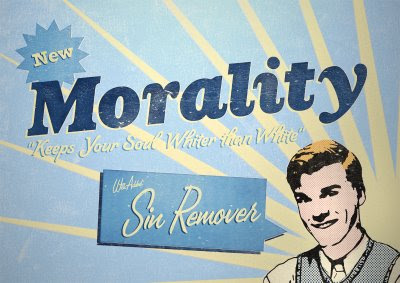 Morality is concerned with right doing and wrong doing. Thou shalt cannot be separated from thou shalt not. I have found, however, that many who are eager to praise something as morally good or condemn something as morally bad are not as eager to describe why they think that something is morally good or bad. In a way I do not blame them for their reluctance. Perhaps they suspect that if they started to strip off the tinsel wrappings of what they call "morality" they might find that there is nothing there - that morality is a myth. There is also the problem that those who are supposed to be experts on the subject very rarely agree as to how to define it. For example, in A Dictionary of Philosophy, published in 1976 by Routledge, it is stated that a "moral principle might be defined as one concerning things in our power and for which we can be held responsible .... or a moral principle might concern the ultimate ends of human action, e.g. human welfare. Other views have it that a moral principle is one which people in fact prefer over competing principles, or else which they should prefer. Others again make principles moral if a certain kind of sanction is applied when they are violated. Universalizibility has also been used to define moral principle."
Is such a verbal hotchpotch what most people have in mind when they talk of morality? I do not think so. What they mean when they say something is moral is that that something ought to be done. What they mean when they say something is immoral is that that something ought not to be done. As the moralist Stuart Smith wrote: "The supremacy of the moral law means that the law should not be broken even if by doing so we gain something which is good or even if by keeping it we have to endure things which are bad....We do not regard a man as keeping the moral law who observes its requirements towards some
of his fellows and disregards them towards others. We only regard a man as keeping the moral law who sees that law as binding in his relations to all men....A moral man is not a man who is moral to those he knows and likes....but one who is moral towards all men, for the sake of the moral law."
Smith is clearly and unambiguously of the opinion that morality consists of obedience to the moral law, that the moral law is above all other laws and that it applies to all human beings without exception. It is such a view, I think, that lies behind what most people mean when they talk of morality. I am aware that there are moralists who will dissent from such a view, labelling it extreme or unworkable, but to me it appears the only consistent attitude that can be taken by someone who believes in the need for a moral code. To introduce qualifications such a workableness is to introduce the question of expedience and the expedient is not the moral.
The question for me, however, is: Why should I be "moral"? What is the justification for demanding my obedience to a
moral code?
Until recently one of the most common of these justifications was an appeal to "God" and, indeed, it has not completely disappeared. This god tells us what is right and what is wrong - so runs the belief. However, even supposing that such a god exists, I have no way of knowing whether the moral commandments ascribed to this god are uttered by him her or it. I am simply told that I must obey them. If I refuse to obey, then I am told that this god will punish me. By threatening me in such a manner, however, the moralist has changed the question from one of morality to one of expediency, to one of my avoiding the painful results of not submitting to someone or something more powerful than I am.
Of course, there are those who do not believe in a god who are nonetheless believers in morality. These moralists seek a sanction for their moral codes in some other fixed idea: the "common good", a teleological conception of human
evolution, the needs of "humanity" or "society", "natural rights", and so forth. A critical analysis of this type of moral justification soon shows that there is no more behind it than there is behind "the will of God". Although, for example, there is much talk about the "common good" any attempt to discover what precisely this "good" is will reveal that these is no such animal. All there is is a multiplicity of diverse and often conflicting opinions as to what this "common good" ought to be. Freedom of speech is held by many people to be in the "common good", but a good number of these would deny that freedom to those holding what are considered to be "racist" views. To be free to express such views, it appears, is not in the "common good". On the other hand, the so-called racists might well argue that freeedom to express their views is in the "common good". The "common good", therefore, is not something about which there is a clear and common agreement. It is merely a high-sounding piece of rhetoric used to disguise the particular interests of those making use of it.
It is exactly this dressing up of particular interests as moral laws that lies behind morality. All moral codes are the inventions of human beings who want what they believe to be "right" to be accepted by all to whom the code is meant to apply. An individual, or group of individuals, wants to promote his or their interests and preferences. To make known these interests plainly, to say that I or we want you lot to behave in this fashion because that would serve my or our interests, would reveal the demand for what it is, that is a demand to do this or that for the benefit of those making the demand. I want to promote my interest and I want to persuade other people to support me. If I am frank about this I might get the support of those whose interest coincides with mine, but that is all. If, on the other hand, I claim that I am speaking in the name of God, or Humanity, or in the interest of the Nation, then my claim becomes much more impressive. This way of demanding gains me the advantage that anyone who disagrees with me I can denounce as being "evil", since they are opposed to the moral good. Bullshit baffles brains and it is certainly
true that in the sphere of morality the ability to use a guilt-inducing technique in an effective manner is an
invaluable emotional weapon. Without such bullshit so-called moral demands would lose their allure and would be reduced to simple commands whose carrying out would depend solely on the power of those making them. Might would make right - until a greater might came along.
There are some who might well agree with much of what I have said so far on the grounds that it refers to a belief in a moral absolute or some objective moral standard neither of which, they will argue, exist. Authentic morality, they believe, can only be experienced on an individual, subjective level and rests upon what an individual feels to be "right". They look neither to God, nor to the "common good" or its variants, as sanctions, but to feeling or intuition.
The problem for such people is that they have no way of proving that they are morally right to do such and such, and that someone doing something opposite is morally wrong. If they are confronted with someone who is acting in a way that violates their feeling of moral rightness, but which that someone claims, on the basis of his feeling, to be morally right, what can they do?
Suppose I believe that abortion is morally wrong, because I have a strong feeling that it is, and you believe that abortion is morally right, because you have a strong feeling that it is, how can the matter be resolved? If we both stick to our conflicting feelings then we have a situation in which one moral right is in direct opposition to another moral right and no compromise is possible since one can only abort or not abort- one cannot half-abort. I accumulate all the evidence I can about the dangers of abortion, I issue sensational statements about crying foetuses and invoke varying degress of indignation about denying the sacredness of life. You point out the dangers of having unwanted and unloved children, the right of women to control their own bodies, the physical and mental risks of having too many children all too often in circumstances where they cannot be given a good life, and so on and so forth. Neither of us convinces the other. The result is a moral deadlock that can only be broken by going beyond what is "moral" and finding out who is the strongest party - those who oppose abortion or those who support it.
Morality is therefore a myth, a fiction invented, as I have said, to serve particular interests. As a myth it nonetheless has its uses, and it is because of these that I do not anticipate that, any more than religion, it will disappear. I have no vision of muddled moralists being replaced by clear-headed amoralists, much as I would personally like to see it.
One of the most popular uses of the moral myth is to add a garnish to the often unsavoury dish of politics. By turning even the most trivial of political pursuits into a moral crusade one can be assured of the support of the credulous, the vindictive and the envious, as well as giving a pseudo-strength to the weak and the wavering. A good illustration of this was the moral diabolization of the former prime minister Margaret Thatcher. To have read and heard what her political opponents had to say about her role as someone of unparalleled wickedness is to have thrown into stark relief what I said about morality being used as a cloak to cover particular interests. Whether one believes that under her rule the country went from glory to glory or sank ever deeper into a terrible mess, it was quite clear that she alone could not have been responsible. Nevertheless, even even those who hold that individuals amount to nothing and that "social" or "economic" forces determine everything did not hesitate to berate her as a kind of demon queen. It was, indeed, astonishing how the mere mention of her name was enough to turn historical materialists into hysterical mysterialists! But then, the turning of political conflicts into campaigns for moral salvation and purity is often a paying proposition for politicians. Many millions have been slaughtered in the cause of creating a new moral order or defending an old one. As Benjamin de Casseres once pointed out those who claim to love "humanity" are usually sentimental butchers.
It is true, of course, that those who engage in such crusades are not always mere cynical manipulators of the credulous crowd. There are undoubtedly those who sincerely believe in the validity of the moral principles they preach, however many exceptions reality may compel them to make. But it will be interesting to see how many of these sincere
moralists will grapple with certain global applications of their beliefs. Take, for example, the birth rate which, according to a recent United Nations report, is increasing at a phenomenal rate in certain parts of the world - this decade alone will see the addition of another billion to the world population. If this rate of increase continues then a time will come when all the ingenuity of the agronomists will be exhausted and the amount of food available will drastically diminish in relation to the amount of food needed. Expanding needs will run headlong into finite resources. Suppose that among those who will have to decide who is to live and who is to die there are those who firmly believe in the "right to life", that is that every human being, by the mere act of being born, therefore has the moral right to all that is necessary to ensure their life and well-being. How will they confront the choices that will have to be made? They will only have two alternatives: to discard their moral principle or to be paralyzed by the inability to apply it. Either way their particular moral stand will be exposed for the sham that it is. The use of the moral myth clearly has its limitations. Like all myths it may have its soothing properties and useful deceits, but when taken literally it can be poisonous.
To say that something is morally good or morally bad boils down in the end to nothing more than that something is said to be morally good or morally bad. What will be said to be good or bad will depend upon the belief of the moralist making the statement. When moral judgements class behind all the verbal pyrotechnics there is simply one idea lodged in one head and another and different idea lodged in another head. The passion with which they are expressed is merely a symptom of the unfulfillable desire to prove the unproveable.
For myself, I have no use for the myth of morality, except as a source of amusement or data for a study of slavery to fixed ideas.
It is high time to stop the repetition of the statement that anarchy represents the ideal of the greatest possible liberty. Liberty consists in the ability to do certain things, that is, to enjoy and possess certain properties; and since property is by its nature limited, the giving of all liberties to all men, the granting to all men of the right to perform all acts, would simply mean the restriction of the share of each - to the benefit of none and the injury of many. People ingenuously believe that liberty is a thing to be distributed, and that it would be well to give it to all men. Universal liberty, on the contrary, would result in a greater number of unimpeded actions, that is to say, in universal helplessness. The anarchistic ideal is not only impracticable; it is self-contradictory.
...anarchists have failed as yet to understand that since the liberty of all is a contradiction in terms the only liberty which can be established is the liberty of a limited number - that is to say, the power of a limited number, the government of a class. Those who are free exercise power; that is to say, they possess the greater part of all properties, including the labour of other men. And it is clear that any society in which the few are free must necessarily contain many who are slaves.
Despotism is the only practical ideal of anarchy.- S.E.Parker
 Die erste Reaktion auf die Kritik, der Rundfunk und Fernsehen hier unterzogen werden, wird lauten: Eine solche Verallgemeinerung sei verboten; es komme ausschließlich darauf an, was wir aus diesen Einrichtungen machen; wie wir uns ihrer bedienen; für welche Zwecke wir sie als Mittel einsetzen: Ob für gute oder für schlecht, für humane oder für inhumane, für soziale oder für antisoziale.
Dieses, aus der Epoche der ersten industriellen Revolution stammende, optimistische Argument – sofern man eine Redensart so nennen kann – ist ja bekannt; und in allen Lagern lebt es mit der gleichen Unbedenklichkeit fort.
Seine Gültigkeit ist mehr als zweifelhaft. Die Freiheit der Verfügung über Technik, die es unterstellt; sein Glaube, dass es Stücke unserer Welt gebe, die nichts als „Mittel“ seien, denen ad lib. „gute Zwecke“ angehängt werden könnten, ist reine Illusion. Die Einrichtungen selbst sind Fakten; und zwar solche die uns prägen. Und diese Tatsache, dass sie uns, gleich welchem Zwecke wir sie dienstbar machen, prägen, wird nicht dadurch, dass wir sie verbal zu „Mitteln“ degradieren, aus der Welt geschafft. In der Tat hat die grobe Zerspaltung unseres Lebens in „Mittel“ und „Zwecke“, wie sie in diesem Argument vollzogen wird, mit der Wirklichkeit nichts zu tun. Unser von Technik erfülltes Dasein zerfällt nicht in einzelne, säuberlich gegeneinander abgegrenzte, Wegstücke, von denen sich die einen durch das Straßenschild „Mittel“, die anderen durch das „Zwecke“ ausweisen.
Legitim ist die Aufteilung nur bei Einzelhandlungen und isolierten maschinellen Prozeduren. Dort, wo es ums „Ganze“ geht, in der Politik oder in der Philosophie, nicht. Wer unser Leben als ganzes mit Hilfe dieser zwei Kategorien artikuliert, betrachtet es nach dem Modell der zweckbestimmten Handlung, ja bereits als technischen Vorgang: was Zeugnis gerade jener Barbarei ist, übt die man, namentlich wenn sie als Maxime „der Zweck heiligt die Mittel“ auftritt, so gerne empört ist. Die Abweisung dieser Formel bezeugt die gleiche Plumpheit wie deren (übrigens höchst selten ausdrückliche) Bejahung: denn auch der Abweisende bejaht ja, wenn auch ohne es auszusprechen, die Rechtmäßigkeit der zwei Kategorien; auch er konzediert ja, dass deren Anwendung auf das Leben als ganzes legitim sei. Eigentliche Humanität beginnt aber erst dort, wo diese Unterscheidung sinnlos wird: wo Mittel sowohl wie Zwecke von Lebensstil und Sitte derart imprägniert sind, dass angesichts von Einzelstücken des Lebens oder der Welt gar nicht mehr erkannt, ja gar nicht mehr gefragt werden kann, ob es sich ihnen um „Mittel“ handele oder um „Zwecke“; erst dort, „wo der Gang zum Brunnen so gut ist wie der Trunk.“
Was uns prägt und entprägt, was uns formt und entformt, sind eben nicht nur die durch die „Mittel“ vermittelten Gegenstände, sondern die Mittel selbst, die Geräte selbst: die nicht nur Objekte möglicher Verwendung sind, sondern durch ihre festliegende Struktur und Funktion ihre Verwendung bereits festlegen und damit auch den Stil unserer Beschäftigung und unseres Lebens, kurz: UNS.
Ehe man die Kulturwasserhähne der Radios in jeder ihrer Wohnungen installiert hatte, waren die Schmids und Müllers, die Smiths und Millers in die Kinos zusammengeströmt, um die für sie in Masse und stereotyp hergestellte Ware kollektiv, also auch als Masse, zu konsumieren. Es läge nahe, in dieser Situation eine gewisse Stileinheit: eben die Kongruenz von Massenproduktion und Massenkonsum, zu sehen; aber das wäre schief. Nichts widerspricht den Absichten der Massenproduktion schroffer als eine Konsumsituation, in der ein und dasselbe Exemplar einer Ware von mehreren oder gar zahlreichen Konsumenten zugleich genossen wird. Für das Interesse der Massenproduzenten bleibt es dabei gleichgültig, ob dieser gemeinsame Konsum ein „echtes Gemeinschaftserlebnis“ darstellt, oder nur die Summe vieler Individualerlebnisse. Worum es ihnen geht, ist nicht die massierte Masse als solche, sondern die in eine möglichst große Anzahl von Käufern aufgebrochene Masse; nicht die Chance, dass alle dasselbe konsumieren, sondern dass jedermann auf Grund gleichen Bedarfs das Gleiche kaufe. In zahllosen Industrien ist dieses Ideal vollständig, oder doch nahezu, erreicht. Dass es von der Filmindustrie optimal erreicht werden kann, scheint mir fraglich. Und zwar deshalb, weil diese, die Theatertradition fortsetzend, ihre Ware noch als eine Schau für Viel zugleich serviert. Das stellt zweifellos einen altertümlichen Restbestand dar. Kein Wunder, dass die Rundfunk- und TV-Industrie mit dem Film trotz dessen gigantischer Entwicklung, in Wettbewerb treten konnten: beide Industrien hatten eben die zusätzliche Chance, außer der zu konsumierenden Ware auch noch die für den Konsum erforderlichen Geräte als Waren abzusetzen; und zwar, im Unterschiede zum Film, an beinahe jedermann.
Und ebenso wenig erstaunlich, dass beinahe jedermann zugriff, da die Ware, im Unterschied zum Film, durch die Geräte ins Haus geliefert werden konnte. Bald saßen also die Schmids und die Smiths, die Müllers und die Millers an vielen jener Abende, die sie früher zusammen in Kinos verbracht hätten, zu Hause, um Hörspiele oder die Welt zu „empfangen“. Die im Kino selbstverständliche Situation: der Konsum der Massenware durch eine Masse, war hier also abgeschafft, was natürlich keine Minderung der Massenproduktion bedeutete; vielmehr lief die Massenproduktion für den Massenmenschen, ja die des Massenmenschen selbst, auf täglich höheren Touren. Jeder wurde durch dieses en masse Hergestellte als Massenmensch, als „unbestimmter Artikel“ behandelt; jeder in dieser seiner Eigenschaft, bzw. Eigenschaftslosigkeit, befestigt. Nur, dass eben, und zwar durch die Massenproduktion der Empfangsgeräte, der kollektive Konsum überflüssig geworden war. Die Schmids und Smiths konsumierten die Massenprodukte nun also en famille oder gar allein; je einsamer sie waren, um so ausgiebiger: der Typ des Massen-Eremiten war entstanden; und in Millionen von Exemplaren sitzen sie nun, jeder vom anderen abgeschnitten, dennoch jeder dem anderen gleich, einsiedlerisch im Gehäuse – nur eben nicht um der Welt zu entsagen, sondern um um Gottes willen keinen Brocken Welt in effigie zu versäumen.
Massenregie im Stile Hitlers erübrigt sich: Will man den Menschen zu einem Niemand machen (sogar stolz darauf ein Niemand zu sein), dann braucht man ihn nicht mehr in Massenfluten zu ertränken; nicht mehr in einen, aus Masse massiv hergestellten, Bau einzubetonieren. Keine Entprägung, keine Entmachtung des Menschen als Menschen ist erfolgreicher als diejenige, die die Freiheit der Persönlichkeit und das Recht der Individualität scheinbar wahrt. Findet die Prozedur des „conditioning“ bei jedermann gesondert statt: im Gehäuse des Einzelnen, in der Einsamkeit, in den Millionen Einsamkeiten, dann gelingt sie noch einmal so gut. Da die Behandlung sich als „fun“ gibt; da sie dem Opfer nicht verrät, dass sie ihm Opfer abfordert; da sie ihm den Wahn seiner Privatheit, mindestens seines Privatraums, belässt, bleibt sie vollkommen diskret. Wahrhaftig, das alte Wort, dass „eigner Herd Goldes wert“ sei, ist von neuem wahr geworden; wenn auch in einem völlig neuem Sinn. Denn Goldes wert ist nun nicht für den Eigentümer, der die conditioning Suppe auslöffelt; sondern für die Eigentümer der Herdeigentümer: die Köche und Lieferanten, die die Suppe den Essern als Hausmannskost vorsetzen.
Über die Tatsache, dass die Mehrzahl der Menschen in heutigen Massengesellschaften durch die Belieferung mit Massenerzeugnissen und durch den Druck der Massenmedien geprägt werden, gibt es keine Meinungsverschiedenheit. Diese Tatsache wird nicht etwas nur behauptet, sondern vor allem praktiziert: und zwar von den Lieferanten selbst, die, um in der Lage zu sein, die Übertölpelbarkeit und Modellierbarkeit des Menschen ausnutzen, also den „schlechten Kunden“ Mensch in einen guten Kunden zu verwandeln, Research - Unternehmungen aufs üppigste dotieren, und die Übertölpelbarkeit des Menschen aufs systematischste studieren lassen. Der Gedanke, dass der Herstellungsvorgang mit dem, was man gewöhnlich als den Produktionsprozess bezeichnet: also mit der Herstellung der dinglichen Produkte, sein Ende finde, ist kindlich.
Es ist zunächst plausibel, dass, wenn Entscheidungen als „gewünschte Entscheidungen“ geboten werden sollen, die Deutungen der getroffenen Entscheidungen genau so fertig geliefert werden müssen wie diese Entscheidungen selbst; dass zur Entscheidung also als integrierender Bestandteil gehört, wie diese gedeutet werden soll; dass auch die Deutung vor-entschieden und unmittelbar mit der Entscheidung mitgeliefert wird. Das bedeutet aber – und damit formulieren wir eine für die konformistische Situation wesentliche Neutralisierung: Einen Unterschied zwischen Fakten und deren Interpretation darf es nicht geben. Dieser Unterschied muss verwischt bzw. unterschlagen werden. Dieses Prinzip wird tatsächlich strikt durchgeführt. Niemals werden Interpretationen als Interpretationen präsentiert, niemals als Ansichten, sondern stets als Fakten.
Und wenn die gelieferte Meinung eo ipso assimiliert, eo ipso als eigene Meinung aufgefasst wird, dann gibt es natürlich auch keine andere, die geäußert werden könnte. Annulliert ist also außerdem der Unterschied zwischen Hören und Sprechen. Was erzielt werden soll, ist „höriges Reden“. Die Definition des Menschen als zoon logon echon wird nun entwertet. Denn ein Sprachwesen ist der Mensch nun nur noch deshalb, weil er ein Wesen ist, das hört. -
Günther Anders
 He is there night and day, old Nehewoué, the guardian of the cemetery.
Each rising sun finds him sleeping, exhausted as he is by night work, and the light of every moon sees him stand.
He goes to gather the herbs that conjure: they conjure life and they conjure death.
He knows, old Nehewoué, how to conserve the spark that animates the old man, and he can extinguish the hearts of strong men, just as we suffocate a torch underneath our feet.
From far off, we come to see the guardian of the cemetery and consult with him; with the one who lives with the dead that sleep in the branches and the dead that sleep under the earth.
He hears the sounds that climb and the sounds that descend, Nehewoué the guardian of the dead.
What do the bones say to you, Nehewoué, when they crack in the branches with the wind's breath?
Do you hear the worm in the flesh? Do you hear the eager hawk?
Why have you become powerful and terrible, Nehewoué? It's because you live with the dead, and death is more powerful than life.-
Louise Michel
 The sentiment is widespread – the slogan has been tirelessly repeated, but almost nothing has been said about what actually can be done to “smash the State”. Here are a few practical suggestions:
Refuse to work for any agency, department, or bureau of government. Disaffiliate yourself from any employment that furthers coercion, no matter what form. Forget about trying to “change from within”; sure you have to make a living, but if you're working in a government research laboratory or a Selective Service office, your efforts aid, not hinder, government control. Remember – the State desperately needs to co-opt your talents. If you and thousands like you resigned, far more good could be accomplished than by furthering authoritarianism in fact while opposing it in theory. Build alternatives to the present form of society.
Actively resist the State's domination over you in whatever ways you are able. But don't feel guilty when you find there are too many injustices for you to fight them all. The State should feel guilty, not you. Do what you can.
Continually improve your ability to express yourself in at least one language. Strive after perfection in the usage of your native tongue. Learn it well and use it often. It is your one friend, your basic tool, and your fluency and persuasiveness in it will ultimately determine whether or not your ideas are accepted by the people.
Write write write write write. Constantly write and speak to get your thoughts before a wide audience. Set forth what you have to say in as understandable a form as you can contrive. Don't be afraid to reiterate; the diffuse genius with scores of ideas he expresses once only, will be overlooked and lost in obscurity. The persistent man who expresses, restates, enlarges upon, and expounds his single thought – he stands a chance of being heard. Incessant repetition and doggedness elevates mediocre or false ideas to the stature of truth, and low, mean men to high positions. Now let's use the technique to get rid of them.
If you oppose authority, you are an Anarchist. The implements of your trade are the typewriter and the printing press. Ignore the secret police provocateurs who will try to persuade you to take up bombs and guns against the State. If every Anarchist in the world killed twenty government agents and dynamited $100,000 worth of government offices, all that would happen would be that every Anarchist in the world would be sentenced to death. The State would not be deflected even an iota from its normal patterns. But with the typewriter and the printing press, you can manufacture articles far more deadly and effective than bombs. Buy a mimeograph machine and learn how to use it. Long after the smoke and destruction of a bomb is forgotten, products of your imagination and creativity can live on, making tiny explosions inside people's minds.
Running through the streets screaming unintelligibly; giving the clenched fist salute and yelling “power to the people” – are superb gestures. For the insane. But if you think about it, the very thing we want to end is “power”, at least power of people over other people. So a slogan like “power to the people” (What power? Which people? Power to do what? To whom?) essentially has no meaning. Too inexact. And even if it did have any meaning, shrieking and howling it through the streets at night in a mob would be a next to worthless way of communicating that meaning. It might be even worse than worthless, because some individuals who might have taken you seriously will now dismiss you and your ideas as idiocy. Who knows? Maybe they're right. Reject the pigs who call for trashing and looting. Nine of ten such episodes end in punishment for innocent people, while the pigs who caused it all get safely away. Even if anything does come down on the guilty, they just rip off their friends to pay the fine, or bail or whatever. They never suffer. In fact, they're probably chortling all the way to the FBI office. Keep away from such people if you really want to smash the State.
Never neglect your education. Learn as much as you can about as many subjects as you can – avoid writing or speaking in ignorance. If you have no idea what's inside a computer, don't spout reams of theory about what computers can do or you may be wrong. If you can't produce a coherent explanation of how an electric doorbell works, don't extol the virtues of technology, or you may be made to appear ridiculous. Talk about subjects you know, otherwise you will only do harm.
Thoroughly dissect and expose the numberless inconsistencies of governmental theory. Hammer away at the State's lies, false assurances, mistakes, stupid errors and injustices. The time hasn't quite arrived when back numbers of newspapers and magazines are altered daily to conform to a legislated view of reality; hence, though politicians strive frantically to maintain an air of infallibility, we can still point out how their hasty, expedient prognostications of yesteryear have not yet been borne out by subsequent facts.
Oppose religion wherever and however possible. When at long last deistic superstition vanishes from the face of the earth, the States of the world will have lost their principal mode of effecting and enforcing subservience and abject humility. Erasure of religion's mind-befuddling contradictionism will enable individuals to live without fear and psychosis, freely interacting and accepting responsibility for their own actions.
Always fight on your own battlefield. Refuse to be drawn into disadvantageous conflict planned and stacked against you. If pigs stop you when you are alone and push you and call you names, flash a glassy smile and say nothing. Why fight when and where they choose? Wait till you get to the place of your choosing – the typewriter, printing press, or microphone, for instance; then hit them with all you've got. If they try to beat you at your own game, they will be as much at a disadvantage as you were in theirs. Basic logic patterns and language fluency you have developed can cast pigs into ridicule and annihilate them.
At some time you will discover that an associate close to you is a secret police agent. People you thought were friends will slowly reveal themselves as latent politicians or thieves trying to rip off movement funds. Don't tremble or become discouraged – fight on – write on.
Never trust anyone. Nobody but you can be depended upon to carry out projects you conceive, so learn how to do everything yourself. That way, no matter if everyone abandon you, all will continue as before. Propaganda will roll on with no lessening of intensity, and the Anarchist idea will be broadcast without even a moment's dead air.
Intensify your life. Struggle to cut down on the amount of time you lose by sleeping. Naturally one must rest, but an extra hour of working time a day adds up to more than a whole extra day each month, more time available than most so-called “anarchists” put in during a year of do-nothing ego-trips. Using time wisely, a single fanatic can equal or surpass the efforts of an entire organization of whimps.
Work selflessly and untiringly, give everything you can, do whatever is in your power to aid those unjustly imprisoned by the State. Know, however, that when you are imprisoned, inevitable in this totalitarian society, you and your efforts will be forgotten, and you will languish abandoned.
So live every day as though it is your last. Save time out to look at the trees and stars; to consider what you are doing; to reaffirm your committment to the world of ideas, to propaganda, to non-violence – to Anarchism!
The world will be little changed for what you do. Your work will be misunderstood and grossly misrepresented. You will be detested. But you are smashing the State.
Don't ever give up. -
Fred Woodworth
 Hello? Are you asked this too? "What!? No cell phone!?" It doesn't seem enough to reply, like Bartleby, "I would prefer not to." So I thought I'd enter my own testimony into the public record. Not necessarily as manifesto, polemic, or pledge-drive, and certainly with no new revelations. But just an impromptu survey to see what I think, and against which you might evaluate your own experience. This could just as easily be why I don't own a car. Or a tv. But cellphone it is, especially given a curious, recent true-life-event (recounted further along down this trail). For convenience, you can remember my points with three words: need, speed, and health.
Need is simple. I was talking with my neighbor Marc Bittner recently, author of The Wild Parrots of Telegraph Hill. I asked him if he finds himself having to justify his lack of a cellphone. For sure, he agreed. Just the other day, a stranger he was talking to at a party learned he didn't own one. He smiled to me and shrugged as he relayed her shocked reaction. "What!?" she'd exclaimed. "How can you do business!?"
Could she envision how writing a book means long continuous stretches of unbroken solitary concentration? Free of distractions tugging at one like the sound of some mouse scampering invisibly at hand nearby. No, writers are not most people. As poet e.e. cummings put it, in a world trying to make each of us into anyone but ourself, we write to be no one but ourselves. So I try to write from that place where I do not own a cellphone, which is how I came into this world, and how I will one day leave.
But a writer's work is a gift. I'm fully aware a cellphone is unavoidably implied in many a job description today. And if you're speculating with your savings, selling stocks and bonds at a moment's notice, it can be crucial.
Moreover, my absence of need reflects a conscious choice, a life of voluntary simplicity. I have no idea how much money I'm saving; that's not the only bottom line to my values. I try to define a middle path between the greatest good and the greatest goods.
Not only do I not need a cellphone, but I positively enjoy my life's basis in something other than need, with need's shadings of want, craving, and greed -- plus the opposite end of its spectrum, of avoidance and aversion. In relative freedom from uncontrollable need, I base my life on breath instead: this wonderful moment, in all its unique texture, shading, and nuance. (See for yourself: be here now.)
A word more about this dimension of, for want of a better word, the spiritual (or, if you prefer, soul). A recent survey found cellphone usage as being predominately about location, saying "I'm here (X) / headed there (Y)." In his book Digital Dharma, American Sufi writer Stephen Vedro cleverly superimposed our communications technology along the chakras, energy centers running along the spine, thus forming a natural hierarchy or ranking. At the base, he infers, is security, being safe; next up, at the pelvis, is relationships. So cellphones are somewhere between those two: fairly low-level. Phones in general have such a narrow bandwidth, compared to, say, video-teleconferences carrying facial expressions. Thus emphasis, subtlety, or nuance means only talking louder (and the Internet has its array of winky "emoticon" face glyphs) which brings me to my next point.
Sum up my lack of need as positive quality of life, but I know I'll still be branded an old fogey. In this generational difference comes a qualitative factor in my decision which could be summed up under the header of speed. The apt title of the classic documentary on the seminal punk rock phenomenon spells out a trinity of modes in which media moulds its users in ways I'm so not about: Louder, Shorter, Faster.
Louder? Who hasn't walked down the street and wondered, "Are you talking to me?" -- only to turn around and see someone behind, talking on their cell like a giddy drunk unaware how loud they are. Doing damage control, we might rank the portable music-player phenomenon ("iPod") as a defensive measure against such proliferation of noise. Being beside someone else's cellphone makes one hostage to half a conversation, reducing the public sphere into a cramped telephone booth without walls. (Quaint analogy, since cellphones have made landline payphones as antiquated as carrier pigeons.) Question: pitting iPod against iPhone, who wins? (I? or I?)
Shorter doesn't refer here to the miniaturization of information technology, but rather duration. It's joined at the ankle with faster. For instance, in our fast-forward pace, Andy Warhol's original dicta that everyone will be famous for fifteen minutes has been abridged to fifteen seconds. Or five. Hence, Twitter, the minimalist media measure of cellphone social networking: 140 characters (spaces included).
So I'm taking a poll: how fast do you talk? (160 words-per-minute seems the maximum speed limit on the Oral Information Superhighway.) When I have to phone for information these days, I feel like a lumbering old highway patrolman pulling some innocent young lady over, having them roll down their window, and telling them, "Excuse me, I'm an old person! Could you please speak s-l-o-w-e-r-?!" Gosh, to the Younger Generation, I must sound like a drawling John Wayne; to me, they sound like a 33 rpm record played at 45 (Alvin and the Chipmunks, say).
Is it the electricity itself that speeds us up, like a subliminal jolt of caffeine? Back in distant memory, a rural New England town was getting hooked up to phone lines. Someone took the opportunity to record the pace of daily speech, before and after phones. After phones, people spoke faster, at the general store, in private conversation, all the time. The Earth resonates at a frequency of 8 hertz (7.83 ±0.50); the electricity running through my apartment walls right now is 60 Hz. You do the math. Watt, volt, and amp have pre-empted more elemental, essential fields of human vibration, such as intuition, imagination, spontaneity.
Of course to set down ideas on the ever-accelerating pace of everyday life within the quickly obsolete medium of print can be a set-up for irrelevance in today's discourse. (Blog! Twitter!) Readers who wish to further explore this phenomenon might consult James Gleick's mass-culture critique of the acceleration of just about everything in Faster (fasterbook.com), or even Paul Virilio's challenging studies of dromology, the logic of speed as basis of technological societies. (Under the latter rubric, I note the cellphone, like much modern technology, was incubated by the military.)
I realize I might sound, thus far, like the caterpillar who said to the other caterpillar, when the butterfly flew by overhead, "You'll never get me up in one of those!" Yet I haven't even begun to directly address the matter of health, which concerns us all. It's a contested field, but worth a sober moment.
These days, we hear talk about acceptable levels of electromagnetic fields (EMFs). But biophysicist Neil Cheery has warned there is no safe threshold level, saying EMFs "enhance cell death rates and therefore they are a ubiquitous, universal genotoxic carcinogen that enhances the rates of cancer, cardiac, reproductive, and neurological disease and mortality in human populations." Prof. Cherry and other scientist have noted that EMF pollution affects plants and animals as well. Indeed, this could well be more wide-reaching than global warming, but without a lone polar bear surfing by on a raft of ice to make the invisible pollution graphic. Lacking one such poster child, consider our children, in general.
It's two decades now since our own EPA deleted from a two-year study the finding that extremely low-frequency fields (EMF) be classified as "probable human carcinogens" alongside such notorious chemical toxins as PCBs, formaldehyde and dioxin (Time, July 30 1990). In that study, five of six case-control studies published in peer-reviewed medical literature showed children living near power lines giving off strong magnetic fields were developing cancer more readily than children who did not live near power lines.
The issue of children being more at risk is indeed graphic. Prof. Om P. Gandhi, Chair of Electrical Engineering at the University of Utah, measures brain penetration of radiation when adults use a cellphone as 30%; 50%, in a ten-year-old's brain; and 75% in a five-year-old. Dr. Michael Klieeison, of the Neuro Diagnostic Research Institute in Marbella, Spain, has shown a two-minute cellphone conversation disrupts brain activity in a child's brain for up to two hours. Is it any mystery that the ministries of health in Britain, Canada, Finland, Germany, India, Israel, and Russia warn against cellphone use by kids under 18? Yet back home Sprint has a two billion-dollar contract with Disney to market cellphones to kids under 12. (It's amusing to think how the hands of Donald Duck or Mickey Mouse just couldn't text, but scary to think at how adept are little human fingers.)
Adult or kid, cellphone radiation affects us all, whether we own one or not. Thus, we're involuntarily the biggest biological experiment in history. (Forget pre-market health tests: we are that test, now in-progress.) In that regard, worse than cellphones are their microwave towers, still signaling weird messages to our protein molecules even after we've flushed our cell down the toilet. It's like cigarettes, and passive inhalation. Cigarettes cause cancer, still they're legal. (Caveat emptor: buyer beware.) You pays your money, and takes your risk. But when a server farm of microwave dishes comes to pump more wireless waves into our neighborhood, where else do we go? Over ¾ of the planet has now gone wireless.
If there is indeed a cancer connection, it's not that cellphones implant cancer cells in the head, like a poison pellet insinuated into our supper. We're all born with cancer cells. It just that sometimes they proliferate far more rapidly than our natural immune system can cope with, often the result of some external stimulus. That simple fact might hold a truly sinister metaphor for cellphones as themselves a kind of cancer, ubiquitous and out of control.
But science is an art, not iron law. So you'll also hear that cellphones are as harmless as genetically modified food that carries its own pesticides. But in my book, health is more than what's told to me by a man wearing a white smock.
I'm a writer and look to the word health itself, where I find the same root as whole, and holy. (And "Hello!") So I wonder: how healthy is it to slip a sound-device against, or even into, the incredibly complex and sensitive human ear canal? Before sound reaches the drum, it's invited to resonate within an acoustic antechamber, the way perfume distills fragrance to the atmosphere.
Consider too the survival value of sound. We cannot see a saber-toothed tiger coming up from behind us in a dense thicket, but our ears can hear 360º. Stop and notice for yourself how sounds orient you in space, near middle and far. (Hint: near might be as close as your very breath.)
While the ear reminds us we are here, society encourages us to plug up our ear canal and be anywhere else, (aka "virtual reality"), an abstract but enveloping realm of comfort, be it talking with a virtual companion or monitoring a distant, now-defunct recording session.
As well as sound, the ear is an organ of balance. Are cellphones a manifestation of what the Hopi people call koyaanisqatsi, life out of balance? I'm not against technology, per se. But I note that technology's gone from being a tool of science, to vice-versa. I think it's really neat I can use a ladder to replace a burned-out light bulb, yet I can also get by just fine on candle light, and in fact do so at least one night a week. Just as there's a Slow Food Movement, so have I my slow life. I'm a writer, but you could just say "creative." The imagination, I've found, works slowly and quietly. I agree with Brenda Ueland, author of If You Want To Write (1933). If you want to write (or just be creative), she notes you need to go slow, and large, to be open to the consoling, noble, free, jovial, magnanimous ideas that are the breath of life. Not brisk as waltzing mice. So, need and speed intertwine, as do all these themes.
Last, but not least, there's multitasking. Today, people drive, eat, talk on a cellphone, and more, all at the same time. Reminds me of the title of a poem by Allen Ginsberg, circa 1966, Consulting I Ching Smoking Pot Listening to the Fugs Sing Blake. Multitasking wasn't yet a word. Originally, it referred to what a computer could do ("parallel processing"): now, people do it too. So do we serve technology, or vice-versa?
Health for me is attending to what's in front of my face, at the moment. It means just eating when eating, not reading: doing both is just an inefficient use of reading and of eating. Watch people eat in public and I think you'll notice they usually spear the next bite on their fork while chewing what's currently in their mouth, without looking, while maybe reading a newspaper (and listening to an iPod). Never fully enjoying each mouthful. Each bite, containing the whole universe. True, maybe some advanced techno-adepts are mastering the art of one-pointed multitasking. But even though there's a migration from the use of hand-held mobile phones while driving to cordless, recent studies have shown they're both multitasking (traffic is one conversation, a phone call's another), both equally dangerous. A recent front-page New York Times study (Dismissing the Risks of a Deadly Habit, July 19 2009) by Matt Richtel, observes that drivers using phones are four times as likely to cause a crash as other drivers, and the likelihood they will crash is equal to that of someone with an .08% blood alcohol level, the point at which drivers are generally considered intoxicated. So just as cellphone use can be a twitching addiction, so too can it be toxic, and fatal.
That night, she left me a sincere voicemail, saying she was praying I'd be alright. I called back to thank her, and to say I pray she never use her cellphone while driving ever again. She fervently agreed yet quickly added, in the same breath, "But it rang!!"
(Hello?)-
Gary Gach


